
1. Two measures that answer different questions
The apparent clarity of transparent films, sheets and glass is determined by two independent optical properties:
Luminous transmittance: the ratio of the luminous flux transmitted through a material to the incident luminous flux. It answers the question: how much light passes through?
Haze: the proportion of transmitted light scattered away from the incident direction. It indicates whether the material looks cloudy and whether an image seen through it remains clear.
The two are not equivalent. Frosted glass can have relatively high transmittance but very high haze: light passes through, yet the image is blurred. For highly transparent materials such as tobacco-packaging BOPP film and food-packaging film, complaints about poor clarity often result from high haze rather than insufficient transmittance. Standard practice is therefore to measure both properties and include both in the acceptance specification.
2. Measurement principles and standards
The main measurement approach uses an integrating sphere. A collimated beam passes through the sample and enters the sphere, where measurements are taken for hemispherical transmittance (all transmitted light) and diffuse transmittance (scattered transmitted light). Haze is the ratio of diffuse to hemispherical transmittance.
Three commonly used standards specify their own measurement conditions:
- GB/T 2410-2008, Determination of the Luminous Transmittance and Haze of Transparent Plastics, used in China;
- ASTM D1003, from ASTM, commonly used in international trade;
- ISO 14782:1999, from the International Organization for Standardization.
Illumination conditions use either CIE illuminant C or CIE illuminant A, depending on the standard.Before agreeing on acceptance limits, the supplier and customer must agree on the standard and illuminant. Results obtained under different conditions cannot be compared directly.
3. Instrument features: the NHM-500 haze meter
Developed by APL Technology in Beijing, the NHM-500 haze meter uses an integrating-sphere design that meets the measurement conditions of all three standards above. Its main specifications are listed below:
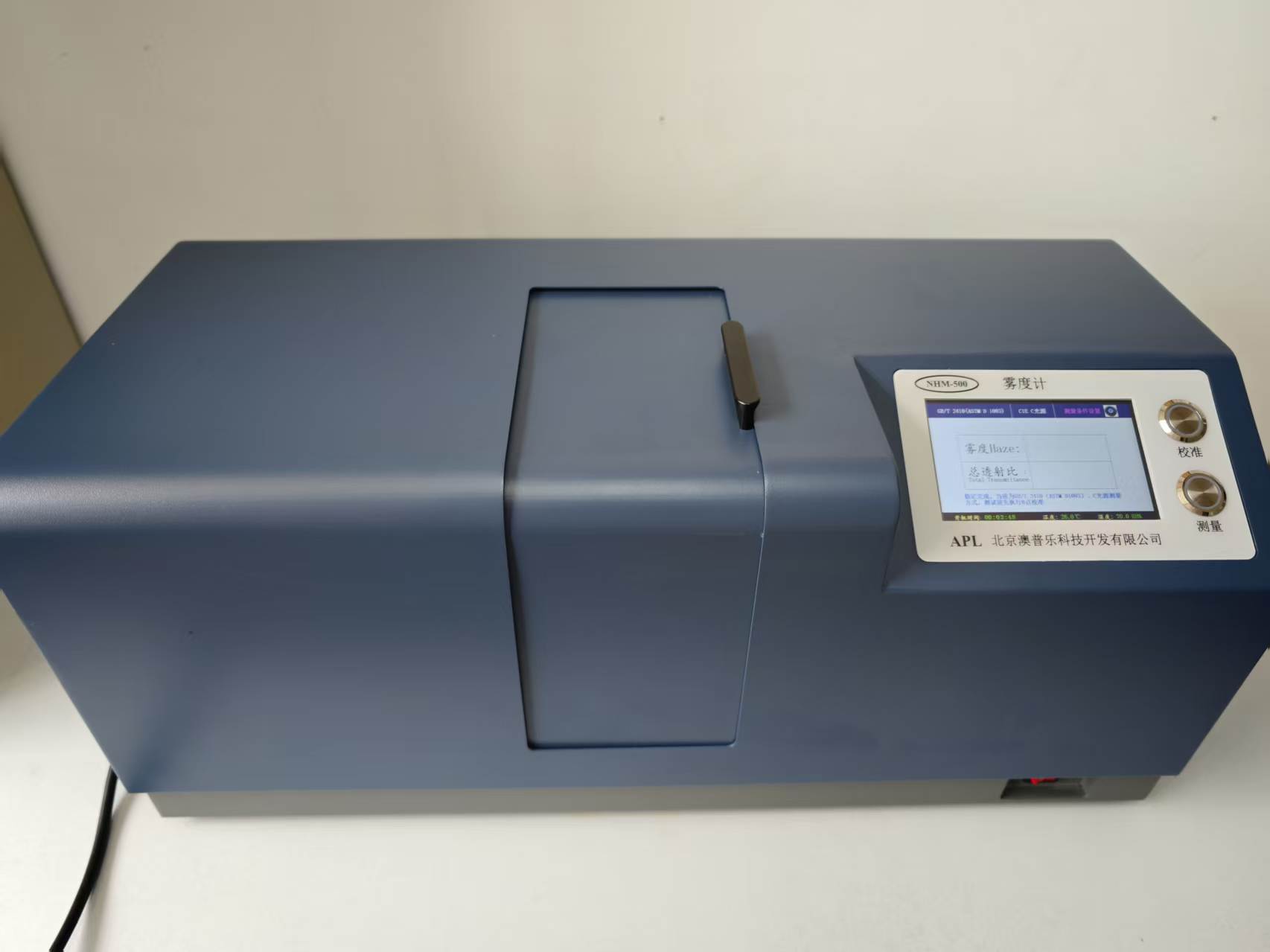
Watch the narrated NHM-500 haze meter demonstration:
| Item | Specification |
| Measured properties | Haze and luminous transmittance (hemispherical and diffuse transmittance) |
| Haze measurement range | 0.1% ~ 95.0% |
| Haze resolution | 0.01 |
| Haze repeatability | 0.01 |
| Transmittance measurement range | 0.01 ~ 1.0 |
| Illumination | CIE illuminant C / CIE illuminant A |
| Standards | GB/T 2410-2008, ASTM D1003, ISO 14782 |
| Operation | Large LCD touchscreen; computer interaction with automatic data transfer and storage |
| Measurement traceability | National haze reference standard |
Several practical design features are worth considering: A well-sealed sample chamber prevents ambient light from affecting measurements; convenient sample positioning places very few restrictions on sample dimensions. The instrument also measures and records ambient temperature and humidity, making reports more complete. Measurements are directly traceable to the national haze reference standard, supporting work by metrology and quality-inspection organisations.
4. Typical applications
- Tobacco-packaging films: outgoing inspection of haze and transmittance in highly transparent films such as BOPP tobacco overwrap. Both are routine optical properties in supplier-customer agreements;
- Plastic film and sheet manufacturers: optical process control, including quantitative monitoring of how raw materials, formulations and stretching conditions affect haze;
- Optical lenses, liquid-crystal display materials, automotive safety glass and architectural glass: incoming and in-process inspection;
- Metrology and quality-inspection organisations: haze measurement of transparent materials with a complete measurement-traceability chain.
For tobacco-packaging films, haze and transmittance testing are often combined with ink abrasion testing using an ink rub tester as part of an appearance-quality inspection programme.
5. Choosing a haze meter
Consider four points: Standards coverage: does the instrument meet GB/T 2410, ASTM D1003 and ISO 14782? Export applications in particular may require several methods; Repeatability: a specification at the 0.01 level is preferable; Measurement traceability: are measurements traceable to a national reference standard? This is essential for metrology applications; Illumination: are both C/A conditions available to match the relevant measurement standard?
6. APL's support
APL Technology in Beijing supplies the NHM-500 haze meter it develops, with installation, commissioning, operator training and periodic calibration services. To establish film haze and transmittance test methods or align supplier-customer acceptance criteria, call 010-83682408 or leave an online enquiry. Sample testing and method demonstrations can be arranged.
7. Frequently asked questions
Does low haze always mean a high-quality film? Not necessarily. Highly transparent packaging requires low haze, but some products need a matte appearance. Set the target range for the intended product and use that range for acceptance.
Will the same film give identical results under different standards? Not always. The three standards use different measurement conditions, so results may differ. Supplier and customer should agree on the standard and illuminant before comparing data.
Are there restrictions on sample dimensions? Very few. A piece can be cut from film, while rigid samples such as glass or lenses can be placed directly in the sample chamber. The sealed measurement arrangement excludes ambient light.